Return to List
MPF vs Provident Fund: A World of Difference in Just One Word! An Article Explains It All
2026.07.30



Hong Kong, with its low tax rates, free capital flow and status as an international financial center, has always been the preferred stepping stone for mainland enterprises to "go global". As global compliance requirements continue to tighten, the rules for company registration and maintenance in Hong Kong have also undergone many changes. Many entrepreneurs find the registration process simple at the beginning, but later in their operations, they face fines, account freezes and even company expulsion due to neglecting details.

This article has compiled 16 frequently-occurring core questions, presented in the form of questions and answers, to help you clarify all the key points throughout the registration to maintenance process, and avoid those "traps" hidden in the details.
I. before registering, make sure to understand these basic questions.
1. What are the core advantages of registering a company in Hong Kong?
The core advantages of the Hong Kong company in 2025 are reflected in four aspects:
Tax benefits: The capital gains tax is implemented in a two-tier system. The tax rate for the first 2 million Hong Kong dollars of profits is only 8.25%, while the rate for the portion exceeding this amount is 16.5%. There is no value-added tax or capital gains tax. The tax system is simple and the tax rate is low.
② Financial Freedom: There is no foreign exchange control, and multiple currency payments can be made and received freely.
③ International Reputation: Hong Kong companies can easily open overseas accounts, conduct financing and listing, thereby enhancing their international brand image;
④ Low registration threshold: No capital verification required. A minimum of HK$1 can be used for registration. One person is allowed to serve as both director and shareholder.
2. Can mainland residents register a company in Hong Kong?
Registration is possible. In Hong Kong, there are no restrictions on the nationality of shareholders and directors. Anyone over the age of 18 can register. However, there are three "hidden requirements" that require special attention:
① A Hong Kong resident or a licensed TCSP (Trust and Company Service Provider) must be appointed as the statutory secretary;
② A physical address in Hong Kong must be provided as the registered address (it cannot be a post office box).
③ Opening a bank account is difficult: Many major banks require proof such as the mainland affiliated company and a genuine business contract; for specific details, please consult our business manager.

3. Can registration be completed without using an agent? What are the risks?
Theoretically, one can submit the application directly through the Hong Kong Companies Registry system, but the risk is relatively high:
①The process is cumbersome: One needs to prepare a complete set of documents such as the NNC1 form, the company's articles of association, and the identity certificates of shareholders and directors on their own.
② Compliance Gaps: There is a tendency to overlook requirements such as the establishment of the SCR (Register of Important Controllers) and the deadlines for annual reviews.
③ Difficult maintenance in the future: One needs to handle annual reviews, audits, tax filings, etc. on their own. If overdue, fines can reach several thousand Hong Kong dollars or even result in the company being expelled from the registry. Entrusting a licensed agency to handle all registration address, legal secretary, and subsequent compliance issues can solve these problems in one go, with a higher success rate.
4. How to check if a company name has already been registered?
You can consult a secretarial company for a company registration check, or you can log in to the online company registration search center of the Hong Kong Companies Registry on your own. You don't need to register an account and can conduct the search for free. The operation process is as follows: Select "Company Name" for search → Enter the proposed name (for Chinese names, use traditional characters) → View the "Full Match" or "Initial Match" results. It is recommended to also check for trademarks to avoid infringement. The search results are for reference only, and the final registration can only be confirmed by the official submission.

5. Which type of registration is the most cost-effective for small and medium-sized enterprises?
It is mainly divided into three categories:
① Private joint-stock company: Limited liability for shareholders, restricted share transfer, suitable for small and medium-sized enterprises;
② Public Joint Stock Company: It allows for public share offerings, but the compliance requirements are extremely high;
③Guarantee Limited Company: No share capital, suitable for non-profit organizations.
For 99% of small and medium-sized enterprises, a private limited company is the most cost-effective option: low maintenance costs, limited liability, and it can meet the requirements for opening bank accounts and conducting cross-border business.
II. Comprehensive Explanation of Registration Process, Funds, and Address
6. How long does the registration process for a Hong Kong company take?
Latest process:
Name Search
② Preparation documents (shareholder and director's identity information, address proof, information of the registered company, etc.)
③ Submit for registration
④ Payment of fees (registration fee + business registration fee)
⑤ Receive the certificate.
Processing time: Electronic certificates can be downloaded as early as the same day or the next day. Paper certificates will be delivered by mail in approximately 4 working days. If you entrust an agent, the entire registration process will usually be completed within 3-5 working days.
7. How should the registered capital be set? Should it be as high as possible?
Absolutely not! The registered capital of a Hong Kong company does not require verification. A minimum of 1 Hong Kong dollar is sufficient. Drawbacks:
① The larger the share capital, the higher the stamp duty during the subsequent share conversion and capital increase (calculated at 0.2% of the share capital amount).
② The registered capital represents the maximum liability limit of the company. Writing "100 million Hong Kong dollars" means that it is responsible for 100 million yuan of debt.
Suggestion: For small and medium-sized enterprises, setting the budget between 10,000 and 100,000 Hong Kong dollars is the most common approach. This not only demonstrates their capabilities but also helps control costs.

8. Can a registered address that is a virtual address be used?
It must be an actual address in Hong Kong. It cannot be a post office box. However, a virtual office or an address from a secretarial company can be used. The key requirements are:
It can receive government letters and legal documents.
② The address must be genuine and valid (verified by the bank);
③ You need to register at the registration office and pay the fee. Currently, the bank account opening process is becoming more stringent. Make sure the address can be verified through on-site inspection. Some banks require the submission of lease agreements and utility bills.
9. What are the strict requirements for directors and secretaries?
Director: At least one natural person, at least 18 years old, of any nationality, no requirement for being a Hong Kong resident.
Company Secretary: The strict requirement is that the appointment must be made to a Hong Kong resident or a licensed TCSP institution (holding a trust or company service provider license).
New regulations in 2025 will be more stringent: The SCR (Register of Significant Controllers) must cover the ultimate natural person, and information changes must be reported within 15 days. Failure to update will result in a maximum fine of 500,000 Hong Kong dollars.
10. Do you have a "business license" after registration?
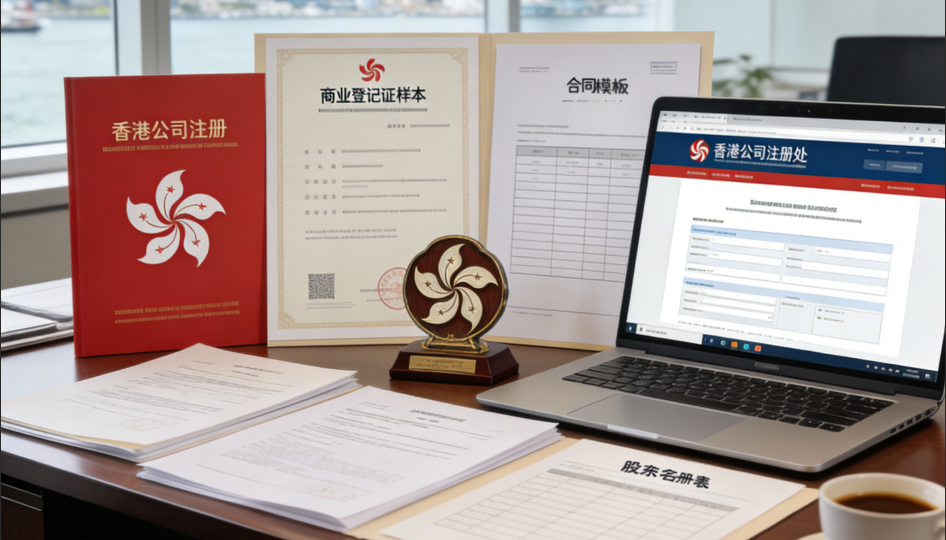
In Hong Kong, there is no concept of "business license". The core documents are two sets of files:
① Company Registration Certificate (CI): The "birth certificate" of the company, listing the name, number and establishment date;
② Business Registration Certificate (BR): The "tax identification number" of the company, which needs to be renewed by payment every year and indicates the business scope. Both of these certificates must be displayed at the business premises and neither can be missing. The complete set of documents also includes the company's articles of association, share certificates, and legal record books, etc.
III. Account Opening and Taxation: The Core Key to Compliance
11. What materials should be prepared when opening a bank account?
Due to global anti-money laundering (AML) regulations, banks are required to verify the authenticity of business transactions to prevent the use of shell companies. Required documents:
The company's complete registration documents (CI, BR, articles of association);
② Identity certificates and address proofs of the directors and shareholders;
③ Business supporting documents: Purchase and sale contracts, invoices, bills of lading, websites, etc.
④ Information of the mainland affiliated company (business license, transaction records, contracts);
⑤ Business Plan
⑥ Proof of Funding Source.
Note: The detailed account opening information, account opening period, and whether a director needs to come to Hong Kong for a face-to-face signature depend on the bank's policies. For specific details, please consult our business manager for further communication.

12. What are the necessary follow-up tasks after registration?
Five must-do tasks:
Bank account opening (within 3 months after establishment);
② Tax registration (obtaining tax number);
③ Annual review (submit NAR1 within 42 days from the establishment anniversary, renew BR);
④ Tax audit (first tax declaration within 18 months after establishment, and declaration is made once a year after each New Year's holiday);
⑤ SCR registration and maintenance.
Omission consequences:
The fine for overdue annual review increases daily, reaching a maximum of 3,480 Hong Kong dollars. If the overdue period exceeds 9 months, the account holder will be disqualified.
② Unaudited tax payment penalty ranging from 5,000 to 10,000 Hong Kong dollars, and the director may be imprisoned.
③The maximum fine for non-compliance with SCR regulations is 500,000 Hong Kong dollars.
13. What are the differences between annual review and audit? Don't get them confused!
Essential differences:
The annual review is an administrative compliance process. It involves submitting the annual return form (NAR1) to the company registration office, updating the information of directors and shareholders, and renewing the business registration certificate.
② Auditing is for financial compliance. Licensed accountants from Hong Kong audit the annual accounts and issue audit reports. The cost varies from several thousand to tens of thousands of Hong Kong dollars depending on the business turnover.
In terms of timing: The annual review is conducted on the anniversary of the company's establishment. For newly established companies, the first audit is carried out 18 months after establishment, and then it is conducted once a year thereafter. Both are completely independent and neither can be omitted. Failure to comply will result in penalties.

14. Can a Hong Kong company issue invoices in the mainland?
We are unable to issue mainland VAT invoices as there is no VAT system in Hong Kong. The Hong Kong company should issue a form invoice instead.
If the company needs to prepare its own commercial invoices or receipts. These documents should include necessary information such as the company name, address, date, description of the product or service, amount, etc., and should be stamped with the company seal or signed by the responsible person, serving as important vouchers for future account verification and tax declaration. Key points for compliant accounting:
All receipts and expenditures must be accompanied by vouchers (contracts, invoices, bank statements).
② Be accounted for in accordance with the Hong Kong Financial Reporting Standards;
③ Entrustment to a licensed accountant for auditing;
④ Retain the accounting records for 7 years.
15. What are the requirements for applying for an offshore exemption?
It is not an automatic exemption. One must apply for it voluntarily during the tax filing process and provide sufficient proof. Latest conditions:
① The business occurred entirely outside of Hong Kong.
② Neither the customers nor the suppliers are located in Hong Kong;
③ Contract negotiation, signing, and performance take place outside the country;
④ The goods will not pass through Hong Kong.
⑤ The board meeting was held overseas.
Complete evidence of the business chain must be provided, such as email records, travel certificates, etc. The tax authority conducts extremely strict reviews, and it is recommended to hire a professional accountant to assist with the application.

16. Can Hong Kong companies conduct business directly in the mainland?
It cannot be directly operated. Hong Kong companies are considered as foreign entities. There are three legal methods:
Establish a wholly foreign-owned enterprise (WFOE): With a Hong Kong company as the controlling shareholder, a physical entity is registered in the mainland, and it can officially operate and issue invoices;
② Brand licensing model: The Hong Kong company licenses the use of the brand and technology to the mainland company, and charges an authorization fee.
③ Establish a representative office: It is only responsible for liaison and market research, and cannot engage in profit-making activities. Additionally, it can conduct business indirectly through cross-border e-commerce or service outsourcing methods.
In recent years, the trend of "lenient entry but strict management" in Hong Kong company registration has become increasingly evident. Registration is just the starting point; continuous compliance is the foundation for survival. Remember three key points:
First, the contact person and address must be in compliance with regulations. Do not take the easy way out by choosing unlicensed services.
Second, annual reviews and audits must be completed on time. Failure to do so will result in much higher costs than the service fees.
Thirdly, the authenticity of business operations is of paramount importance. Both bank account openings and tax filings require a complete chain of evidence.
It is suggested that business owners should create a compliance calendar every year, or entrust a one-stop service agency to focus their efforts on business growth rather than dealing with fines. After all, when doing business in Hong Kong, following the rules is more important than saving money.
Shengsen International is a licensed secretary company in Hong Kong, holding a professional secretary service license (TCSP). With 13 years of registration experience, it offers a one-stop service including Hong Kong company registration, company bank account opening, annual review, and accounting audit and tax filing. It has a team of licensed accountants and has close cooperation with major banks in Hong Kong, which can help you successfully open an account. If you wish to learn more about Hong Kong company business, please scan the QR code for consultation👇
Newbies don't know how to register a Hong Kong company? Here is an all-inclusive guide covering conditions, materials, procedures, maintenance, etc. After reading it, you can do it yourself!
Next article News | 2026.07.30MPF vs Provident Fund: A World of Difference in Just One Word! An Article Explains It All


Please be sure to provide truthful personal information so that we can contact you more quickly