Return to List
MPF vs Provident Fund: A World of Difference in Just One Word! An Article Explains It All
2026.07.30



From January to April each year, it is the peak period for auditing of Hong Kong companies. Many business owners often get confused when seeking auditing services: For the same type of auditing for Hong Kong companies, why is my fee much higher than others? Is it because of inflated charges, or is there something fishy hidden in the low-priced services?

This article, in light of the current increasingly strict regulatory environment, dissects the core logic of the fee differences and helps you avoid the hidden pitfalls on the auditing path.
One, three key factors influencing audit fees
Auditing is not a "assembly line operation". The differences in costs often stem from the enterprise's own operating conditions and the complexity of the audit process:
1. Business flow volume and transaction volume
Auditors need to carefully check each transaction in the bank statements, invoices, contracts, etc. If the company's annual transaction volume amounts to tens of millions of Hong Kong dollars and the transactions are frequent, the auditing process will naturally take longer and the labor costs will increase accordingly.
2. Document completeness and accounting standardization degree
Some enterprises have missing documents, chaotic accounts, and even "off-book transactions". Auditors need to spend a lot of time sorting out and verifying these issues. Such "restorative audits" are more costly.
3. Industry Characteristics and Complexity
Companies involved in cross-border transactions, related party dealings, intangible asset valuation (such as patents, trademarks), or specific industries (such as finance, securities) need to follow more stringent guidelines for auditing, which demands higher professionalism and incurs higher costs.

Two, formal agent vs unlicensed agent: the essence of the cost difference is qualification and responsibility
The amount of audit fees is essentially a reflection of the qualifications, responsibilities and professionalism of the service providers. In the current context of stricter regulation in Hong Kong, the disparity between these factors is far more than just a matter of "price".
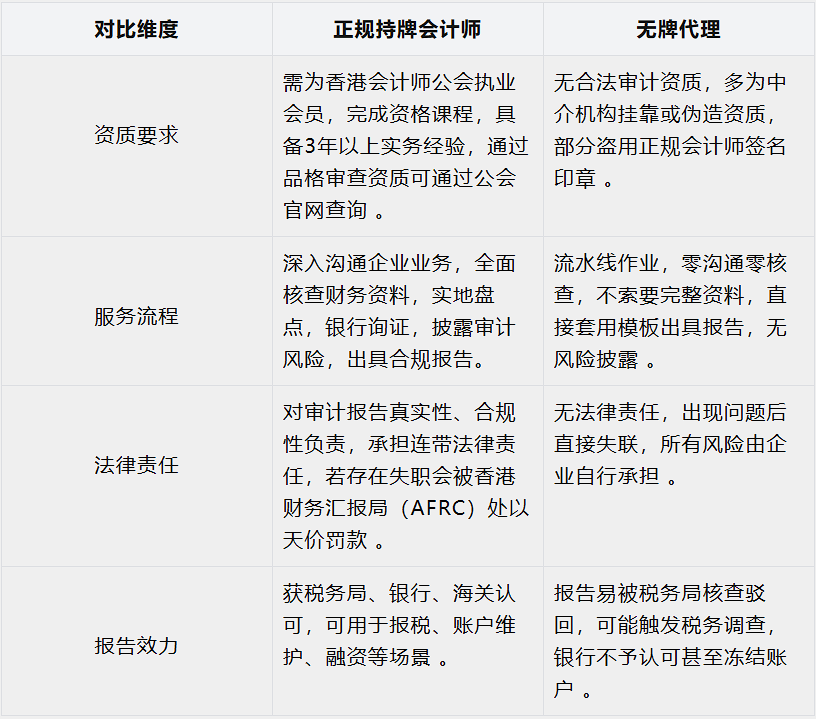
From a cost perspective, licensed accountants need to assemble a professional team, strictly adhere to auditing standards, and bear high professional responsibilities, which naturally makes their fees higher than those of unlicensed agents. Meanwhile, unlicensed agents skip all verification steps and use "low prices" as an attraction, essentially providing worthless and false services.

Three, the fatal hidden danger of low-price audit: save small money, lose big money
The era of "zero declaration" in Hong Kong has come to an end. The number of cases subject to on-site audits by the tax authority has soared. In the 2023-24 fiscal year, the average fine imposed per case reached 11.8 million Hong Kong dollars. The risk of low-price audits has become an unbearable burden for enterprises. The potential risks mainly lie in the following three aspects:
1. Compliance risk: Triggering tax investigations and huge fines
Audit reports issued by unlicensed agents are mostly "template-based products", which often have problems such as incorrect revenue recognition, incorrect inventory valuation, and false disclosures. Once discovered by the tax authority, not only will the report be rejected, but the enterprise will also need to hire a licensed accountant for auditing (incurring several times the cost), and will be subject to tax recovery and fines. In severe cases, the directors may even face imprisonment.
2. Operational risk: Bank account is frozen or cancelled
Hong Kong banks conduct compliance reviews on accounts every year, and the audit reports are the core basis. If the bank discovers that a company uses reports issued by unlicensed agents, it will consider the company to have compliance risks and directly freeze or close the account. For enterprises that rely on Hong Kong accounts to conduct cross-border business, having their accounts blocked means the business comes to a standstill, and recovering the costs is extremely high.
3. Credit Risk: Affecting Long-Term Development of the Enterprise
If non-compliant audit reports are disclosed, the company's credibility in front of its partners and investors will be completely ruined, affecting future cooperation and financing. Meanwhile, the Hong Kong government is establishing a "watchlist" for non-compliant practitioners, and if a company is associated with unlicensed agents, it may be included in the high-risk list and face long-term regulatory scrutiny.

Fourth, how to effectively respond to the audit peak and avoid risks?
The period from January to February 2026 is the critical audit period for companies with year-end settlements. Based on regulatory requirements and industry experience, the following three core suggestions are provided:
1.Plan ahead and avoid the crowds.
The peak period for auditing in Hong Kong usually falls between January and April each year. It is recommended to contact the accountant before the end of the previous year to allow sufficient time.
2. Organize documents to enhance efficiency
Pre-classifying and organizing all the annual accounts, bank monthly statements, invoices, contracts, etc., can significantly reduce the time and cost for audits.
3. Select a licensed firm and sign a formal agreement
Verify the CPA qualification of the accountant and clearly define the service scope, delivery time and cost details in the agreement to avoid future disputes.
4. Viewing Audit from the Perspective of "Integration of Business and Finance"
High-quality auditing is not only a compliance obligation, but also helps enterprises identify internal control loopholes, optimize tax structures, and create long-term value.

The disparity in auditing fees of Hong Kong companies is fundamentally a difference between compliance costs and risk assumption. In today's increasingly stringent regulatory environment, low-cost auditing is not about "good value for money", but rather a time bomb buried in the business operations. Choosing a regular licensed accountant may seem to cost more, but in fact, it helps the company avoid millions of fine risks and business crises.
Shengsen International is a licensed secretary company in Hong Kong, holding a professional secretary service license (TCSP). With 13 years of registration experience, it offers a one-stop service including Hong Kong company registration, company bank account opening, annual review, and accounting audit and tax filing. It has a team of licensed accountants and maintains close cooperation with major banks in Hong Kong, enabling you to successfully open an account. If you wish to learn more about Hong Kong company business, please contact us at the hotline: 153 0279 0432 [vx is the same number] and add WeChat. Professional consultants provide one-on-one services. Welcome to consult at any time👇.
If you want to register a Hong Kong company but don't have an address or a secretary, what should you do? Here comes the guide to avoid pitfalls!
Next article News | 2026.07.30MPF vs Provident Fund: A World of Difference in Just One Word! An Article Explains It All


Please be sure to provide truthful personal information so that we can contact you more quickly